
Digital Herbarium
Faculty of Agriculture and Veterinary Medicine · Lebanese University
Website of the course Plant Systematics · Supervised by Dr. Dani Fadel
The digital herbarium is a collection of pressed, dried plant specimens collected by students of the Faculty of Agriculture and Veterinary Medicine at the Lebanese University during their courses and field trips, and checked by the herbarium team. Each specimen gets a permanent barcode, is identified, scanned, then published here with its collecting data.
The aim is for every wild plant of Lebanon to be represented by reference specimens for teaching and research: checking identifications, mapping distributions, studying flowering times and extracting DNA.
Link with the Flora of Lebanon
The species list (2,888 taxa in 155 families), names updated to WCVP (Kew), Arabic names, descriptions, districts and field photos come from the Flora of Lebanon project. All specimen images are contributed by the faculty’s students. floraoflebanon.org ↗
Standards
- Specimen data follow Darwin Core (TDWG), downloadable and publishable on GBIF.
- Names follow the World Checklist of Vascular Plants (Kew).
- Sensitive taxa: precise localities hidden from the public, as in the Flora of Lebanon.
- Licence: CC BY-NC 4.0, crediting the collector and the herbarium.
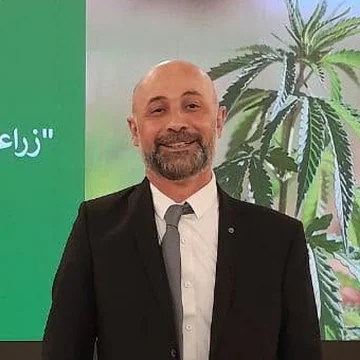
Supervised by · Plant Systematics
Dr. Dani Fadel
Dr. Dani Fadel is a professor at the Faculty of Agriculture and Veterinary Medicine of the Lebanese University, where he has taught since 2010. He gives the Plant Systematics course and directs the herbarium and the students’ work in it. Since July 2025 he has been President of the Regulatory Authority for the Cultivation of Cannabis for Medical and Industrial Use, at the Presidency of the Council of Ministers, leading the regulatory framework for medical and industrial cannabis under Law 178/2020: licensing, and quality standards from cultivation to processing and export.
He graduated as an agricultural engineer (plant production) from the Lebanese University in 2001, took a master’s in natural products and biotechnology at the Mediterranean Agronomic Institute of Chania (Greece) in 2002, and a PhD in the chemistry of natural products at Aristotle University of Thessaloniki in 2010, on the production of phenolic compounds in spearmint clones regenerated in vitro. He holds three post-doctoral certificates: potentially harmful elements in soils and plants (University of Athens, 2014–2015), oil and gas exploration in the Mediterranean (University of Athens, 2015–2016), and cannabinoids from cannabis and pharmacognosy (Aristotle University, 2018–2019).
His research covers producing drugs and natural compounds from plants, cannabis above all, in vitro and in vivo techniques for growing medicinal plants, and protecting society from harmful compounds in plants and soils. He lectured in pharmacognosy, toxic plants and botany at the Lebanese University Faculty of Pharmacy (2010–2014) and was a research scientist with the University of Athens (2014–2025). He took part in the work to legalise medicinal cannabis in the Lebanese Parliament, serves as an expert to the Lebanese courts on the analysis of chemical substances, and advises Lebanese industrial companies on product quality.
Selected publications
- Fadel, D. et al. — on the cannabinoids of the “Karma Lemon” cannabis strain grown in Thessaloniki, Greece. Journal of Agricultural Science 12(7). ↗
- Fadel, D., Assaad, Alghazal, Hamouche & Lazari — on the cannabinoids of the industrial cannabis variety “Finola” grown in Thessaloniki, Greece. Journal of Agricultural Science 12(7). ↗
- Heavy Metals Accumulation in the Edible Vegetables of Lebanese Tabbouli Salad. Journal of Agricultural Science 12(7). ↗
- Potentially harmful elements in Lebanese fattoush salad. International Journal of Agricultural Technology 15(2): 319–332 (2019). ↗
Key references
1867–1888
Flora Orientalis
Edmond Boissier
The monumental Latin flora of the Orient in which many Lebanese species were first described; Post built on its method.
1884
Nabāt Sūriyya wa-Filasṭīn wa-l-Quṭr al-Miṣrī wa-Bawādīhā
George Edward Post
The first systematic scientific book in Arabic on the plants of the Levant and Lebanon; Post gathered the classical and local Arabic names of wild plants.
1896 / 1932–1933
Flora of Syria, Palestine and Sinai
George E. Post; 2nd ed. revised by John E. Dinsmore
The founding work of botany in Lebanon and the Levant, from the Taurus to Sinai; revised and enlarged by Dinsmore in two volumes (1932–1933). Its specimens are kept in the Post Herbarium at AUB.
1930
Flore du Liban et de la Syrie
Louis Bouloumoy
A pioneering French work: a text volume and an atlas of 512 plates, the first complete visual atlas of the plants of Lebanon and Syria.
1936–1953
Flore libano-syrienne
Jean Thiébaut (drawings by C. Jarrier)
A three-part flora based on extensive field trips in Mount Lebanon and the Anti-Lebanon; it added dozens of new records and paved the way for Mouterde.
1966–1984
Nouvelle flore du Liban et de la Syrie
Paul Mouterde (completed by A. Charpin & W. Greuter)
Still the most precise and complete taxonomic reference for the flora of Lebanon and Syria, with dichotomous keys, detailed localities and drawings of each species. The basis of the descriptions on this site.
1970
Weeds of Lebanon
W. S. Edgecombe
Illustrated manual of the weeds of cultivated land in Lebanon.
1978–1980
Wild Flowers of Lebanon / Fleurs sauvages du Liban
Mustapha Nehmeh
The first Lebanese colour-illustrated book combining scientific accuracy with field photography of wild flowers. Its author, Mustapha Nehmeh, was a professor at the Faculty of Science of the Lebanese University and a board member of CNRS-L. Scientific, Arabic, French and English names.
2000
Etymological Dictionary of the Plants of Lebanon
Mustapha Nehmeh
A dictionary explaining the Latin and Greek roots of the scientific names of Lebanon’s wild plants, with their Arabic, French and English names; a key reference for standardising local names.
2001–2014
Photographic Guide to Wild Flowers of Lebanon
Ahmad Houri & Nisrine Machaka-Houri
Pocket field guides for recognising wild flowers by colour and season; the two volumes cover about a quarter of Lebanon’s species, followed in 2014 by a book focused on Key Biodiversity Areas.
2002
Mille et une fleurs du Liban / A Thousand and One Flowers of Lebanon
Georges Tohmé & Henriette Tohmé
The fruit of forty years of fieldwork by Georges Tohmé (former president of the Lebanese University and of CNRS-L) and the researcher Henriette Tohmé: colour photographs and notes on more than a thousand wild flowers of Lebanon in three languages, with habitats, flowering seasons and distribution.
2007 / 2014
Illustrated Flora of Lebanon
Georges Tohmé & Henriette Tohmé
The most complete illustrated encyclopaedia of Lebanon’s wild plants: about 2,597 species in the 1st edition (2007) and over 2,600 in the 2nd (2014), with photographs, ecology and notes on rare, threatened and endemic species.
2013
Native Trees of Lebanon and Neighboring Countries
Elsa Sattout & Hala Zahreddine (ed. Vernon H. Heywood)
A scientific field guide to the native trees of Lebanon and the eastern Mediterranean: morphology, ecological needs, propagation and reforestation.
2014 / 2016
Trees of Lebanon (2014) · Important Plant Areas in Lebanon (2016)
AUB Nature Conservation Center (S. Talhouk, M. Yazbek, K. Sleem et al.)
Two publications of the AUB Nature Conservation Center: “Trees of Lebanon” covers native forest trees with watercolours and a field key; “Important Plant Areas” sets out the national map of priority areas for protecting wild plants.
2017
A Glance at the Wild Flora of Mount Hermon, Lebanon
Safaa Baydoun & Nelly Apostolides Arnold
Field work from a project assessing the flora of Mount Hermon: rare and endemic species of the western slopes, with descriptions, altitude ranges, flowering seasons and traditional uses.
2025
Red List of the Vascular Flora of Lebanon
Ramy Maalouf & Hicham El Zein
The first illustrated red book of Lebanon’s flora: 108 threatened species with photographs, IUCN status, habitats, distribution and main threats.
1791–1812
Icones plantarum Syriae rariorum, descriptionibus et observationibus illustratae
Jacques-Julien Houtou de Labillardière
Plates and Latin descriptions of rare plants Labillardière collected in Syria and Lebanon in 1787–1788, many of them new to science. The plates are shown on the pages of the taxa they depict.
1890–1899
Plantae Postianae, fasciculi I–IX
George E. Post (with Eugène Autran)
Nine instalments listing the plants Post collected from the Syrian desert to Lebanon, Hermon and the Amanus, with the first descriptions of many of his new species.